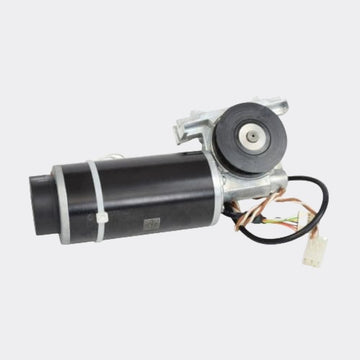
- Product Name
- GEZE ECdrive Standard Motor — replacement gear motor for classic ECdrive linear sliding door operators .
- System Compatibility
- Designed for ECdrive (classic) and selected ECdrive-FR escape-route variants when specified; not the same as ECdrive T2 hardware .
- Drive Concept
- Maintenance-free DC motor with integrated gearbox driving the toothed-belt transmission; closed-loop control via the DCU1 controller with encoder-based teach-in .
- Electrical Context
- Motor stage operates on 24 V DC within the operator; mains supply handled by the operator power unit .
- Operator Performance Envelope (context)
- ECdrive families commonly specified to ≈120 kg per leaf (classic ECdrive), while ECdrive T2 platforms extend capability to up to 140 kg depending on profile and carriage configuration .
- Typical Environmental Range
- Indoor operation around −10 °C to +40 °C, IP20 in the header cavity .
- What's Included
- Complete gear-motor assembly for ECdrive. Controller (DCU1), sensors, battery, belt, carriages, pulley and covers are supplied separately.
- Compliance Context
- When installed and commissioned with conforming sensors/edges and, where applicable, FR components, the resulting system is configured to meet EN 16005 / DIN 18650 requirements for pedestrian sliding doors .
Frequently Asked Questions
Q1. How do I confirm this is the correct "Motor for ECdrive" for my door?
A. Check the header label and documentation. If the operator is ECdrive (classic) or ECdrive-FR, this GEZE EC Motor is the standard style. If your label says ECdrive T2, you need T2-series hardware; some parts are not cross-compatible .
Q2. What symptoms point to a motor fault (not a belt, carriage, or controller issue)?
A. Indicators include: repeated failure of the teach-in despite correct belt tension; thermal trips under normal loads; erratic speed or hunting with good encoder wiring; or a burnt-winding smell. Always verify supply voltages, earthing, belt/pulley condition, and track friction before condemning the motor .
Q3. Does the "Gear motor EC Drive" include an encoder or the DCU1 controller?
A. The ECdrive Standard Motor is the motor/gear unit. It works with the operator's control electronics (DCU1) which read encoder feedback during teach-in. The controller is a separate component .
Q4. What commissioning steps are mandatory after replacement?
A. Run the guided teach programme from the program switch: encoder check → learn open/close positions → friction/force evaluation → mass calculation. Then verify modes (Automatic, Permanent Open, Partial/Half Open, Exit-Only, and any scheduled Night/Bank functions) and document results .
Q5. Will this "ECdriver Motor" run heavy framed leaves?
A. The operator platform sets the certified limit, not the motor alone. Classic ECdrive is widely documented around 120 kg/leaf; T2 raises capability to up to 140 kg with suitable profiles/carriages. Confirm your exact operator model, glazing mass, and profile system .
Q6. Can I keep my existing belt and return pulley?
A. If the belt shows glazing, tooth wear, frayed cords or the return pulley bearing is noisy, replace them with the motor to avoid callbacks. It's best practice to inspect end buffers and carriage wheels while the header is open .
Q7. How does the motor affect compliance and safety?
A. Fresh drive hardware restores the controller's ability to maintain force/velocity profiles and stopping accuracy required for EN 16005 / DIN 18650 commissioning. Compliance depends on the entire system—sensors, edges, and proper teach-in—not the motor alone .
Product Description
For sites that value predictable throughput, quiet operation, and low downtime, the most cost-effective path to "like-new" performance is often a like-for-like gear-motor swap. The GEZE ECdrive Standard Motor is the factory-style GEZE EC Motor engineered for the classic ECdrive architecture. In day-to-day use, it is the difference between a door that glides confidently at opening time and one that hesitates, hunts, or reopens unexpectedly when traffic peaks.
Why this motor restores "factory feel"
ECdrive's mechanical recipe—DC motor + precision gearbox + toothed-belt transmission—is built to damp vibration and deliver smooth motion. Over years of service, bearing wear, partial demagnetization, or gearbox lash can nudge the controller outside its ideal torque window. Replacing the motor resets the baseline, letting the DCU1's closed loop achieve its designed acceleration ramps, hold-open timing, and stop accuracy after a proper teach-in . The result is fewer nuisance reversals from presence sensors, cleaner synchronization with access control, and consistent door behavior across temperature swings and stack-effect conditions that challenge light operators.
Compatibility clarity (what buyers need before ordering)
Classic ECdrive vs. ECdrive T2
The T2 generation modernizes electronics and mechanics, and is documented to support up to 140 kg per leaf in many configurations. That does not imply backward parts interchangeability; match your motor by model code and photos .
FR (escape route) considerations
ECdrive-FR systems add escape-route logic and hardware. The motor form factor is similar, but the controller and wiring determine the escape function. Always verify the door's legal category before ordering .
Electrical expectations
Within the header the motor stage is driven at 24 V DC by the operator; mains is isolated at the PSU. If you see repeated undervoltage or brown-out faults, check PSU outputs and connectors before replacing the motor .
What facility managers care about — and how this motor helps
1) Acoustic comfort for customer-facing spaces
The ECdrive system is known for a quiet signature. A fresh ECdriver Motor tightens speed control and reduces gear noise, preserving the ambience of premium retail, hospitality, and healthcare reception areas .
2) Predictable commissioning and lower lifetime cost
No proprietary laptop is needed. Technicians use the standard program switch to run the teach-in, adjust speeds, and set timeouts. Documenting these parameters creates a reproducible setup for multi-site estates, cutting engineer time and repeat visits .
3) Performance headroom for real buildings
Doors do not run in lab conditions. This motor gives the controller the torque stability it needs to maintain opening speeds and force limits when wind pressure, stack effect, or seasonal drag increases .
4) Portfolio standardization and spares control
Many estates operate a mix of ECdrive and ECdrive-FR. Standardizing on the correct Gear motor EC Drive simplifies truck stock and training, and shortens MTTR across regions .
Field-tested replacement workflow (minimize callbacks)
Identify & document
Photograph the motor nameplate, current wiring, pulley orientation and belt path; pull the controller's error memory and note cycle counts.
Mechanical swap
Isolate power; remove cover; release belt tension; swap the GEZE EC Motor. Inspect belt teeth, cords, return pulley bearing and end buffers.
Teach-in & verification
Run the teach programme (encoder, travel limits, friction/force, mass). Verify Automatic, Permanent Open, Partial/Half Open, Exit-Only, and any Night/Bank routines.
Handover & records
Store parameter sets and cycle counters; schedule preventive maintenance based on environment and cycle profile. These practices increase trust and reduce lifetime cost .
What you receive
A complete GEZE ECdrive Standard Motor gear-motor assembly for classic ECdrive operators. Order controller (DCU1), belt, carriages, sensors, battery pack, and covers separately to match the service scope .